Building a Synthesizer, 13
Building the VCF
- Introduction: The World of DIY Synthesizers
- 1: The mki x es.EDU DIY System
- 2: Building the Power Supply
- 3: Breadboarding the VCO
- 4: A Gentle Introduction to Op Amps
- 5: Building the VCO
- 6: The Logic Circuits Model of Computation
- 7: Building the Mixer
- 8: Building the Envelope Generator
- 9: A Field Guide to Oscillators
- 10: Building the VCA
- 11: Debugging Circuits and Software Debugging
- 12: Breadboarding the VCF
- 13: Building the VCF
- 14: Building the Sequencer
- Glossary and Electrical Connections
This is the second chapter discussing the VCF build; if you haven’t already read the first, you might want to start there. As a reminder, “VCF” stands for “Voltage Controlled Filter.” A VCF can be any kind of filter; the mki x es.EDU VCF is just a lowpass filter. The “Voltage Controlled” for this kit means that we can control the filter’s cutoff using a control voltage signal, such as one produced by the envelope generator. Using an envelope generator allows us to vary the filter’s cutoff over the course of a note, which makes it sound more interesting. Of course there are many, many more ways to use a VCF!
Assembling the PC Board
This turned out to be a fairly easy build. Everything worked correctly after initial assembly. I made one mistake, which was accidentally melting two of the capacitor housings a bit with my soldering iron (I work under a magnifiying lens, and this was out of sight!):
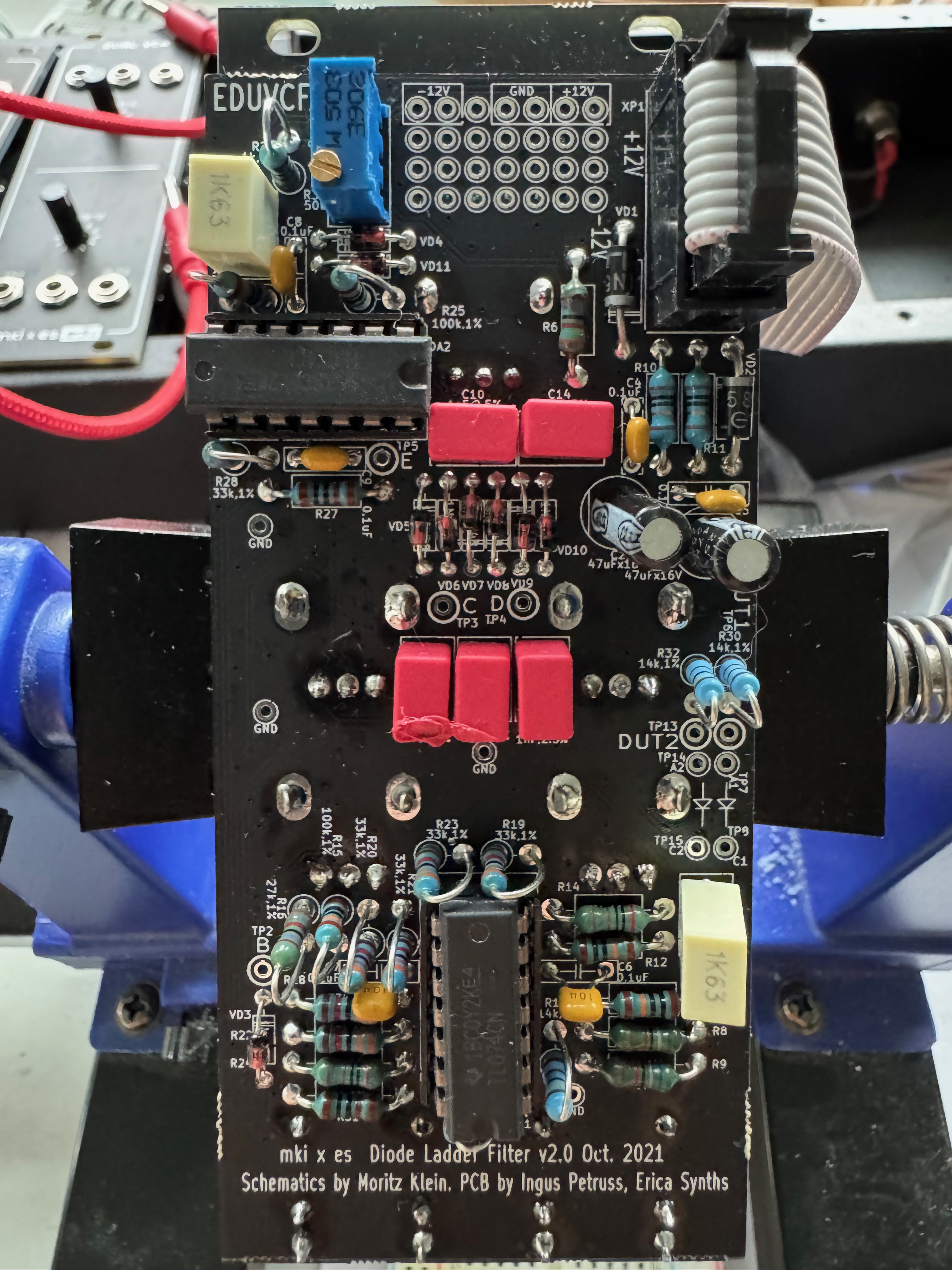
One tip I found handy: Before installing the trimpot resistor, set it to the middle of its range using your ohmmeter, because it’s hard to tell where it’s set once it’s in the circuit. From there you can easily adjust it up or down as needed. I found it needed not adjustment at all, however!
A couple of other views:
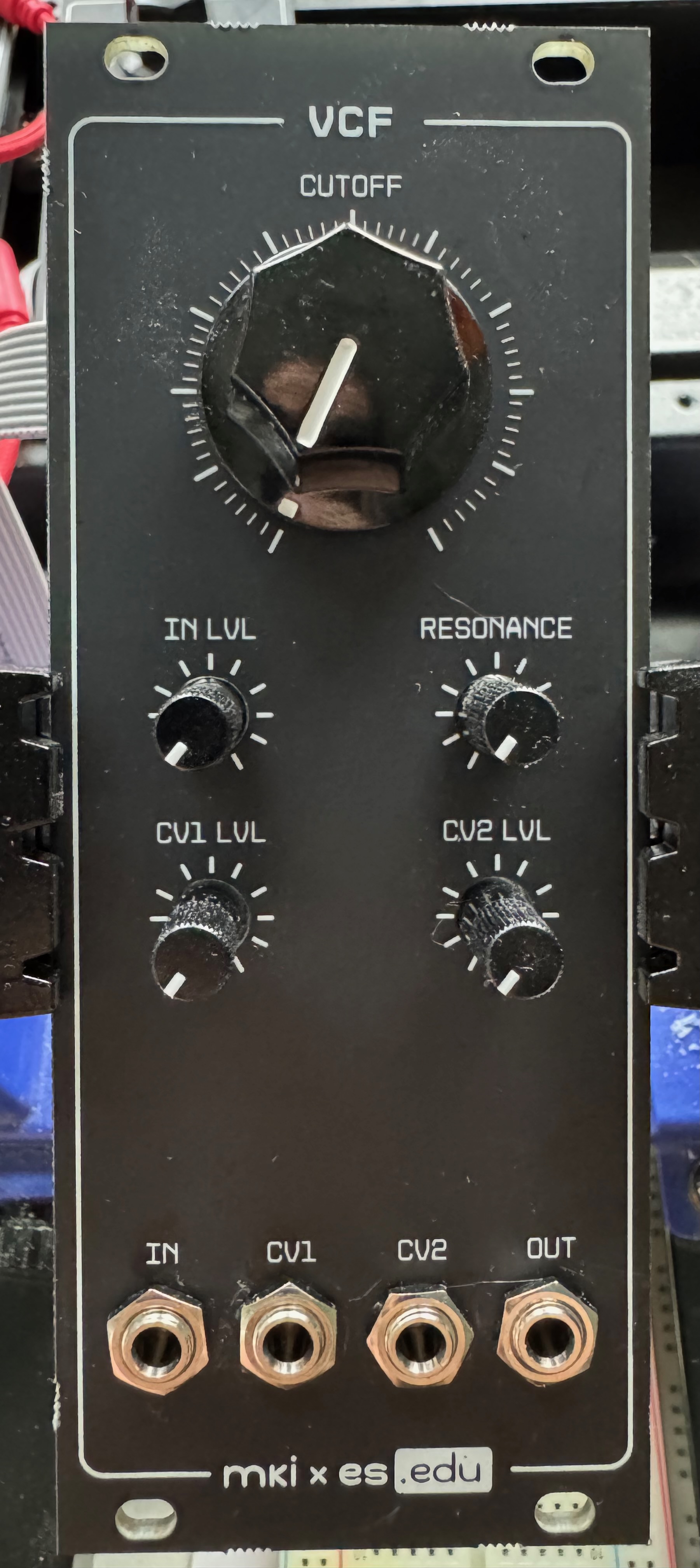
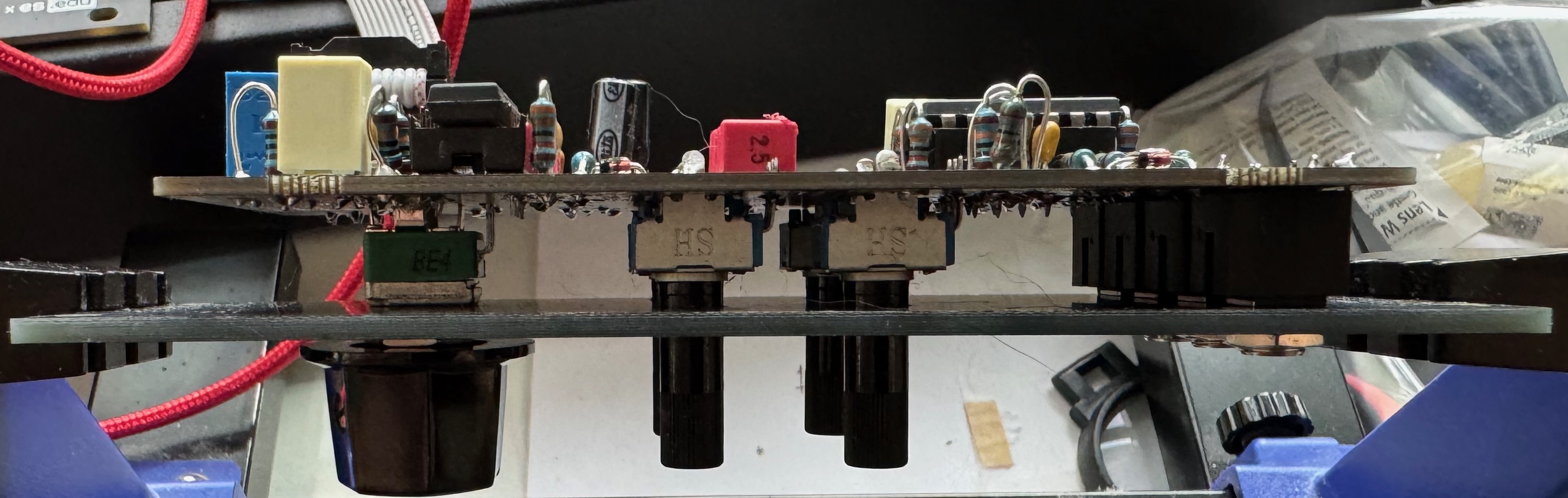
Matching Diodes?
While I was building this PC board, I noticed something a bit strange at the top. There were two spaces for diodes, for which no extra diodes were supplied in the kit.
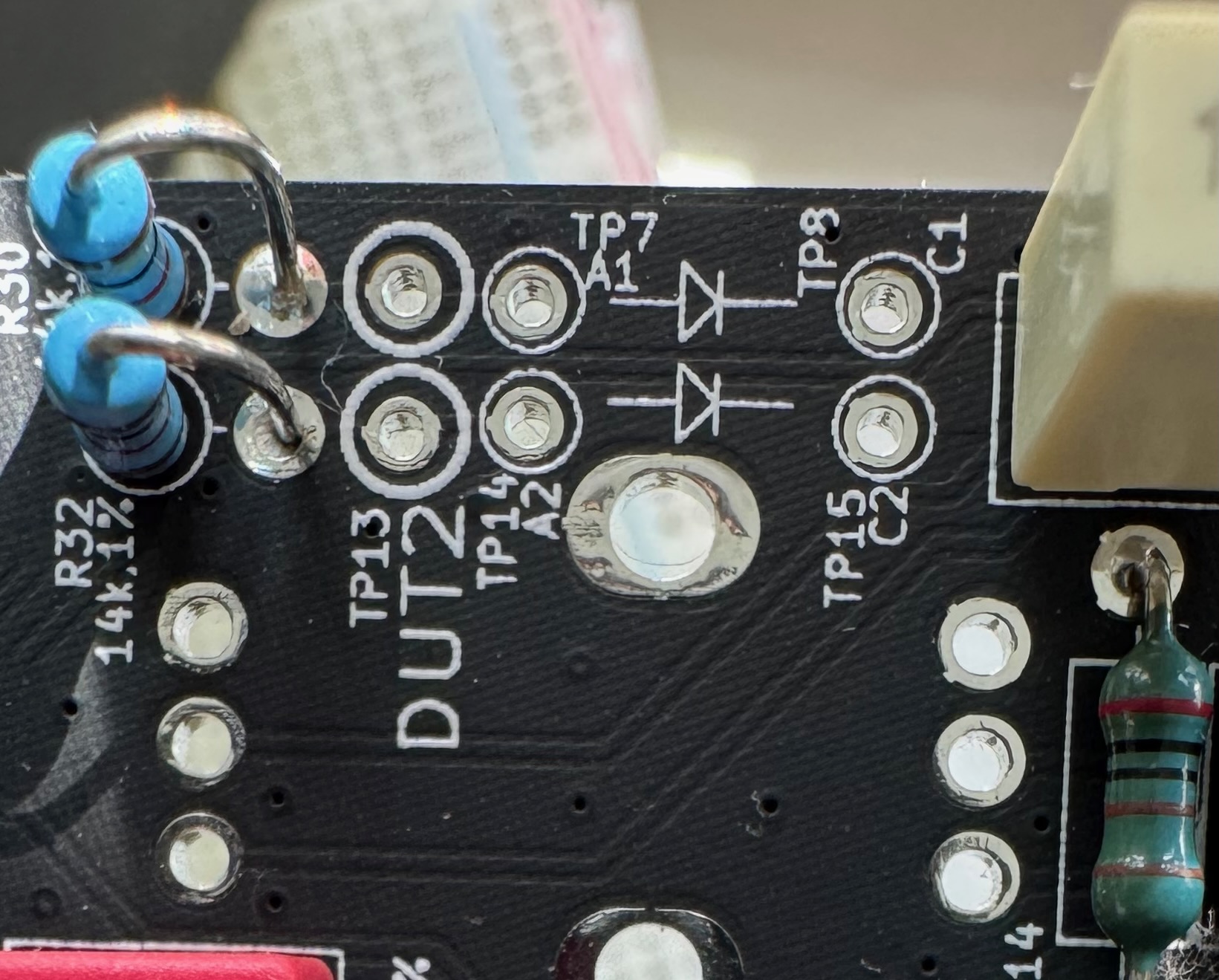
This was not mentioned in the directions, but I found reference to them on the schematic:
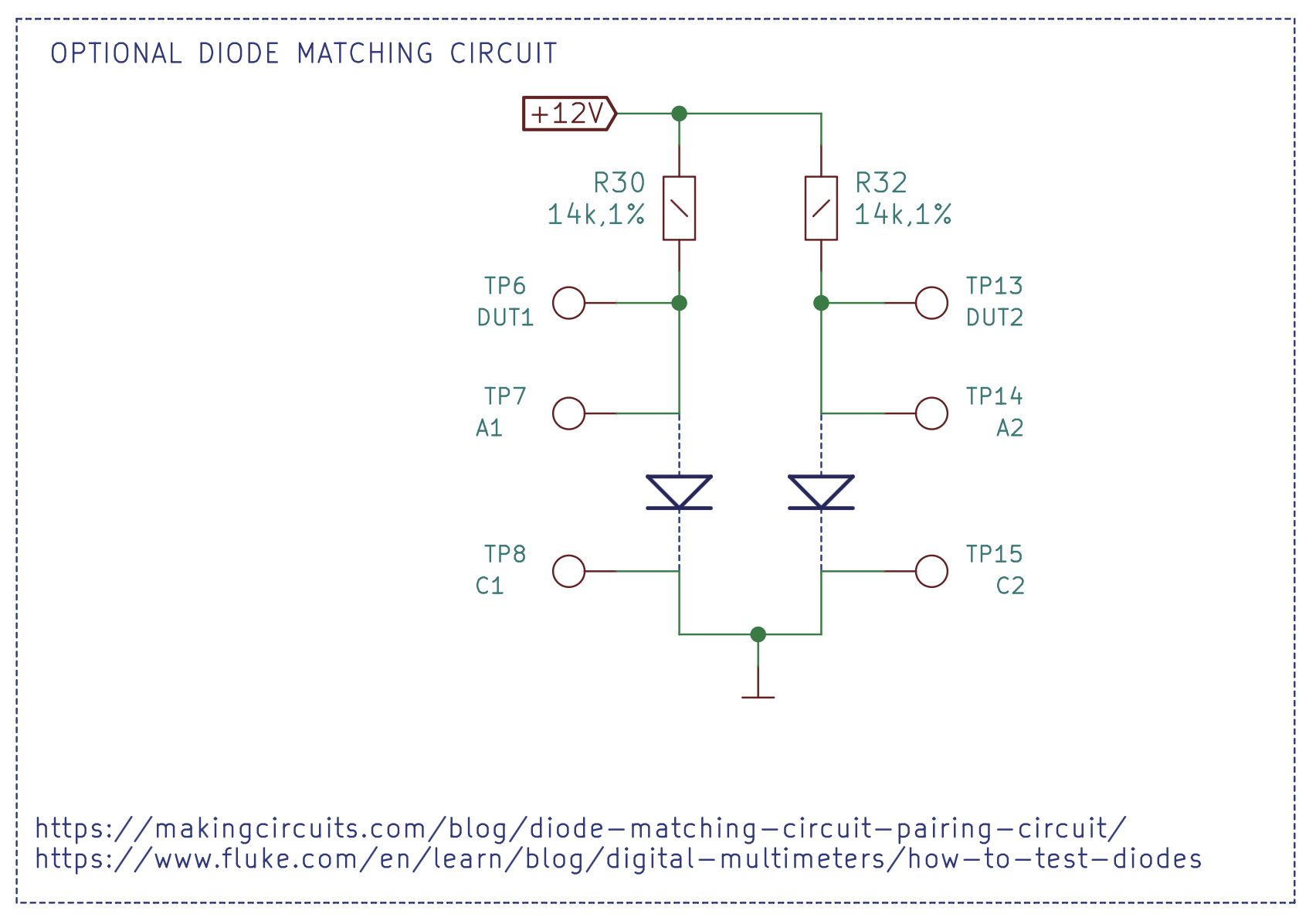
There are two links on the schematic, and they go to an article on diode matching and another on how to measure diodes with your multimeter. The latter is clearly aimed at people who have never used diode mode on their meter before. (No shade intended here! We all need to learn!) The former is sort of interesting, but I can’t understand why this little circuit is on the board at all, because, as Moritz notes:
- Careful matching of diodes is not needed for this circuit
- If you were going to build the circuit from the first link to carefully match diodes, it would make a lot more sense to do it on a breadboard than to solder the diodes onto a PC board temporarily!
So, I didn’t bother to match my diodes. I guess it might make sense to do that if I was trying to build the cleanest filter imaginable, but in this case I prefer a kind of crunchy sound!
Finished!
Here we have a square wave input and three possible settings of the filter: No filtering at all, a low pass filter without resonance, and no filtering but a “medium” amount of resonance:
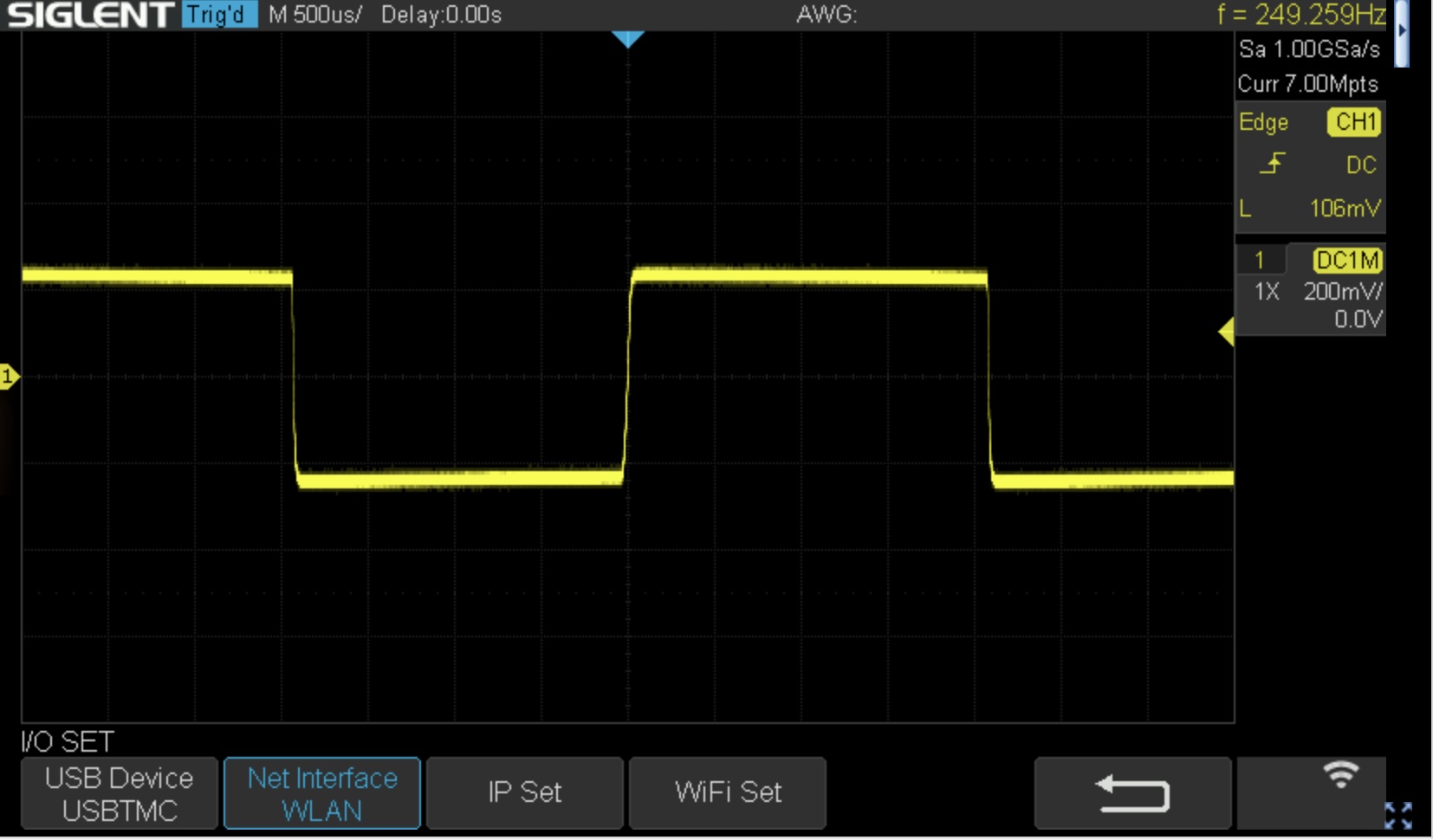
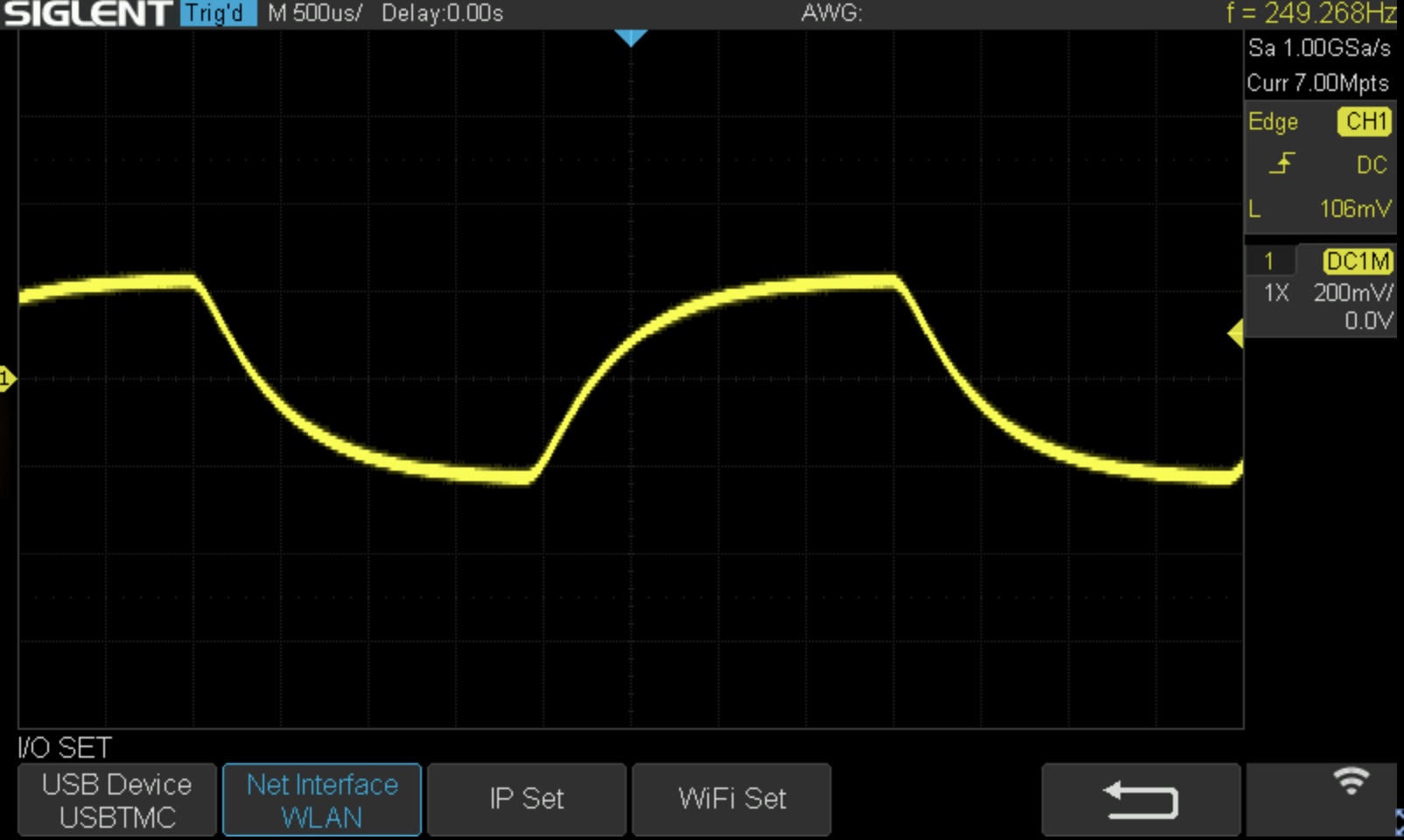
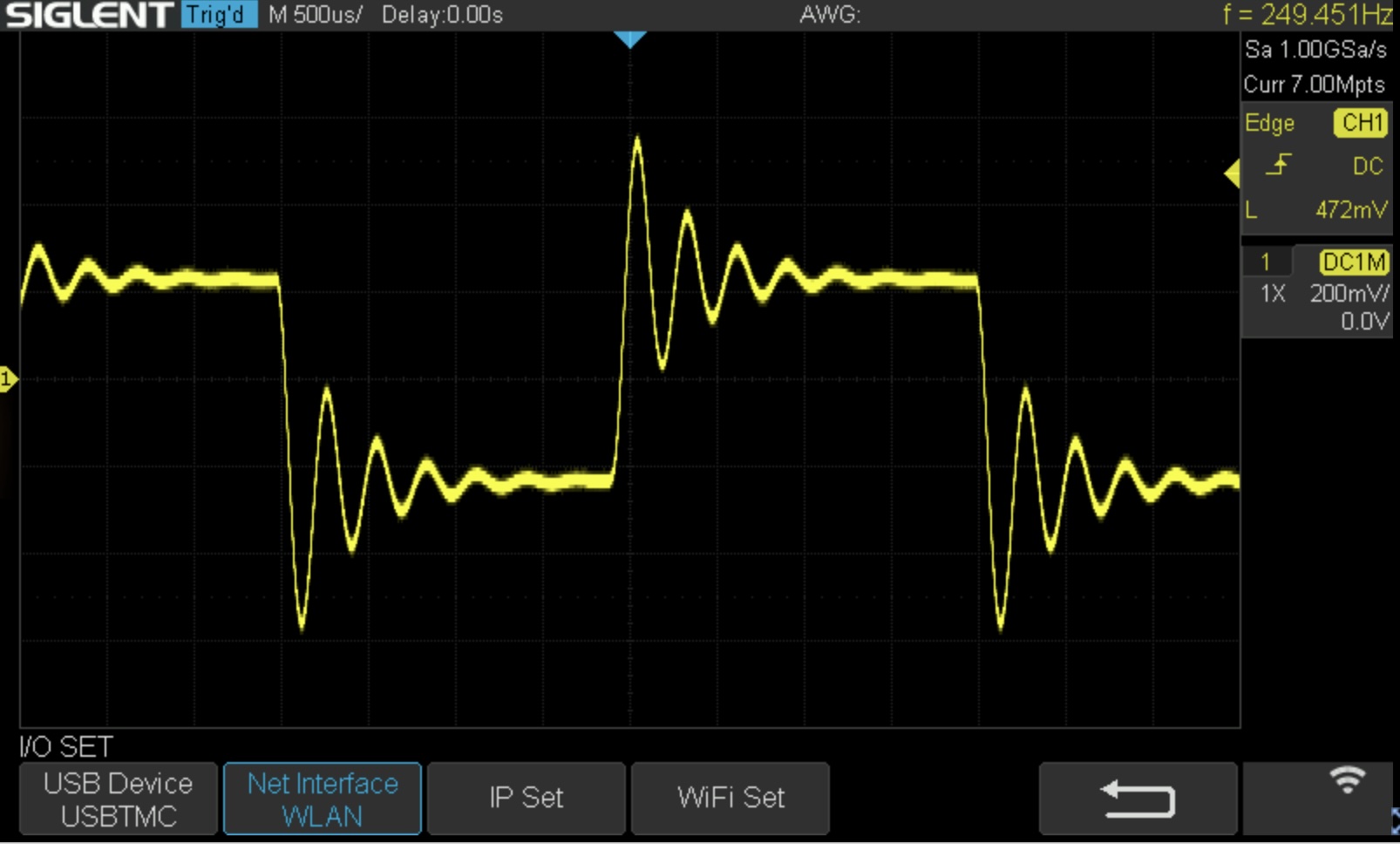
If you turn up the resonance still further you hear a high-pitched feedback.
Next, I connected the output of the Envelope Generator to the CV1 input of this kit, which caused the cutoff to cycle back and forth between “no low-pass filtering, but some resonance,” and and “a low-pass filter with resonance” (this is a video, press play to see it):
At this point you may be wondering how it sounds. Pretty nice! I want to put some demos together, but I will save that for a future post. Hopefully soon! However, it would be nice to have a CV source for the VCO to record a demo, so first let’s build the sequencer!
Resources
Instructions
Product Pages
Community
Simulations
This simulation by Moritz Klein is the closest to the entire kit as built on the PC board
Videos
- Introducing the mki x es.edu DIY VCF kit by Moritz Klein (5:04)
- Erica.EDU Diode Ladder Filter Kit! by Quincas Moreira (16:05)
The folling series of videos are iterations on the design of what is ultimately a slightly different VCF built by Moritz Klein. I do think they are useful, though:
- DIY SYNTH VCF Part 1: Analog Filtering Basics (21:45)
- DIY SYNTH VCF Part 2: Active Filters & Resonance (27:30)
- DIY SYNTH VCF Part 3: Resonant High-Pass & Vactrol-Based Voltage Control (29:20)
- Designing a diode ladder filter from scratch (36:03)
- Turning my diode ladder filter into a eurorack module (34:46)